SCUCISD board calls $295M bond election for May 2
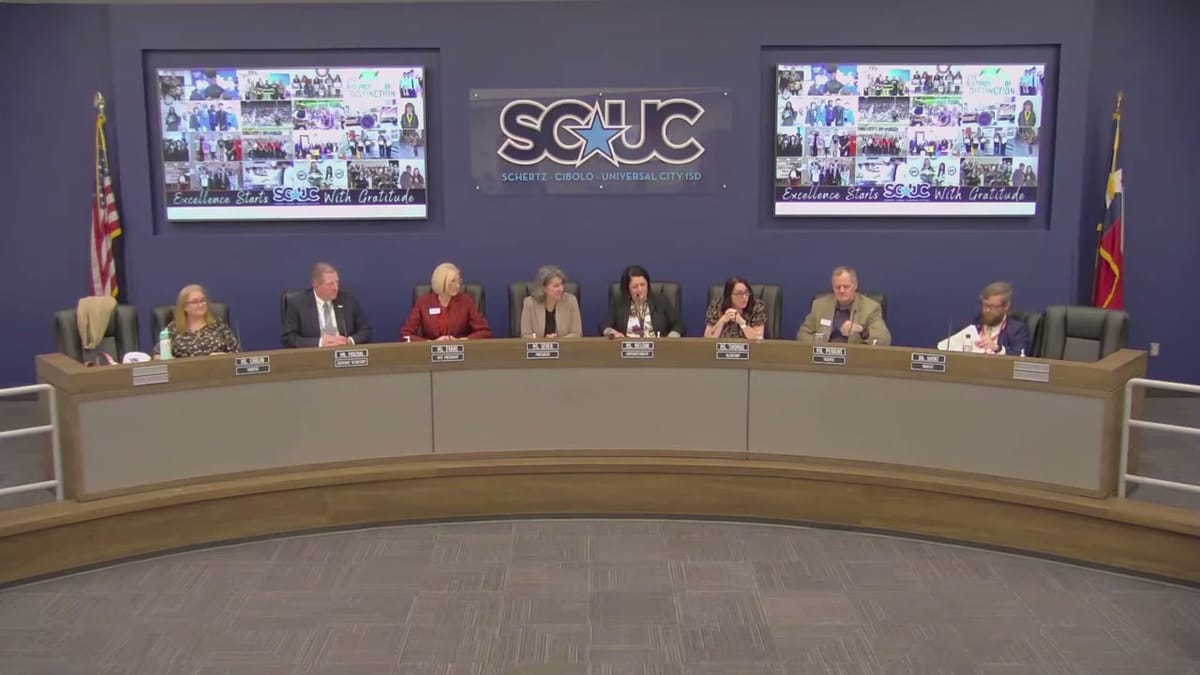
The SCUCISD Board of Trustees voted 7-0 Thursday night to call a $295.1 million bond election for May 2, split across three propositions.
The package breaks down as follows:
Proposition A ($230.7 million) — General Facilities: Campus security systems, classroom and learning space upgrades, fine arts and CTE renovations (including a new CTE building at Steele), HVAC replacements, roofing and drainage repairs, new school buses, playground replacements at elementary campuses, and campus refreshes at aging sites including Dobie Junior High, Steele and Clemens high schools, and multiple intermediate campuses.
Proposition B ($55.3 million) — Stadium Facilities: Renovations to Lehnhoff Stadium including expanded seating, upgraded safety and lighting, new artificial turf at Steele High School, and new turf at Corbett Junior High.
Proposition C ($9.1 million) — Technology: Replacement of student and staff computers, iPads, and Chromebooks.
The board did not discuss these details during the called meeting itself. The district published the breakdown afterward on its website, and Community Impact News reported it.
The bond comes after the district's November 2025 Voter-Approved Tax Rate Election (VATRE) — commonly called a TRE — failed by 98 votes (5,926 for, 6,024 against). A TRE raises the Maintenance & Operations (M&O) tax rate, which funds day-to-day expenses like teacher salaries, classroom supplies, and utilities. A bond, by contrast, is repaid through the Interest & Sinking (I&S) tax rate and can only fund capital projects — construction, renovations, equipment, and facilities.
In short, the two measures draw from different buckets. A TRE keeps the lights on; a bond builds and fixes buildings. The failed TRE and this bond are not interchangeable.
No trustee or administrator discussed the projected tax rate impact during the meeting itself. According to a district news release provided to media on Feb. 13 (reported by Community Impact), the bond is "not anticipated to increase the 2025-26 tax rate," citing rising property values. That claim was not discussed or explained on the record at the Feb. 12 meeting.
Analysis: What "no tax rate increase" actually means
The district's claim warrants closer examination. In Texas, a school district's I&S (Interest & Sinking) tax rate generates enough revenue to cover payments on existing debt. When property values rise — as they have across the Schertz-Cibolo-Universal City area — the district collects more revenue at the same rate, because the tax base has grown. As older bonds are paid off, the debt load shrinks.
Without new debt, this combination of rising values and retiring debt would typically cause the I&S rate to drop. That's not theoretical — it's happening elsewhere in Texas. Grapevine-Colleyville ISD, which has not passed a bond recently, has seen its tax rate decline for seven consecutive years, according to district records, dropping more than 5 cents in the last year alone as old debt fell off the books.
By issuing $295 million in new bonds, SCUCISD is proposing to fill that capacity — keeping the tax rate flat rather than letting it fall. While technically true that the rate may not increase, homeowners with rising appraisals would not see the tax bill relief that would occur if the bond were not issued.
The district has not published a comparison showing what homeowners' bills would look like with and without the new debt.
The vote caps what Board President Letticia Sever described as "the last two years" of board discussions, and a Citizens Advisory Committee process that involved more than 75 community members touring district facilities and narrowing roughly $600 million in identified needs — Sever's figure, Community Impact reported "more than $500 million" — down to the current package.
Before the vote, the board played a professionally produced video featuring CAC members discussing the process. The video is unlisted on the district's YouTube channel — it does not appear in public search results or on the channel page and can only be viewed via direct link.
The video contains no dollar figures, no project specifics, and no tax rate information. Instead, it features emotional testimonials from committee members.
"If we say we value the community, everybody has to be invested. Everybody has to be pouring in," one member said.
Another described the experience as the committee "giving everything that they could mentally and emotionally" and urged viewers to see the recommendation as "something I believe in." A third called the committee "a placeholder for the voices of those in the community."
The video included no opposing viewpoints or taxpayer cost information. The recommendation is "a collective approach involving multi stakeholders," Superintendent Paige Meloni said.
Calendar changed to align with early voting
Earlier in the meeting — immediately before calling the bond election — the board unanimously approved moving a professional development day from Friday, May 1 to Monday, April 27. The stated reason: April 27 falls within the early voting window for the May 2 election, giving staff and parents more time to vote.
The superintendent framed the change explicitly around the bond: "With the potential bond coming up, we would like to consider a twenty twenty five, twenty twenty six instructional calendar change to move a professional development day that's currently set for Friday, May 1 to Monday of that same week, April 27, which would put that date within the early voting window and allow our parents and staff a little more time potentially to vote that day."
At the Jan. 22 regular meeting, where the calendar change was first introduced, Kelly Kovacs described it as aligning with "anticipated civic engagement needs." The shift would "support awareness of the election with our parents," she said. Approval was being sought early so the district could "communicate the change to parents, students, staff as early as possible, minimizing disruption," Kovacs added.
One trustee praised the move: "I just think it's great to support our employees to give them a time which they possibly couldn't have... We're not demanding that they do. It's just an opportunity for them to go out and do so."
No trustee raised concerns. It passed 7-0.
Context: The district's May election strategy
The calendar change takes on additional significance in light of earlier board discussions. At the June 24, 2025, regular meeting, during a legislative update on bills that passed and failed during the session, a district administrator told the board: "Thank goodness we can still do May elections. That's the big takeaway from House Bill 19 not making it through."
House Bill 19 would have required school districts to hold bond and tax rate elections in November, when voter turnout is significantly higher. A 2012 Berkeley study found that bonds pass at rates of 77–90% in low-turnout May elections versus significantly lower rates in November. The Texas Public Policy Foundation has called the practice a deliberate strategy, writing that "low-turnout bond elections are no coincidence." In May 2025, Texas districts sought a record $37.7 billion in bonds on the low-turnout date.
So the sequence is: the district celebrated keeping the ability to hold a May election, then changed the school calendar to move a day off into the early voting window for that May election.
Two ways to read it
On one hand, the change is facially neutral. The board didn't tell anyone how to vote — it simply freed up a weekday during early voting. Supporters would argue that encouraging civic participation benefits the entire community regardless of how anyone votes. The district gave families advance notice and moved the day within the same week.
On the other hand, the sole stated justification for moving the PD day was the district's own bond election. No pedagogical reason, no teacher scheduling feedback, no other rationale was offered. The parents and staff who already planned around the published calendar now have a different schedule — and the only reason is the bond. District employees, who would directly benefit from bond-funded facility improvements, are among those most likely to use the freed-up day to vote.
We could find no other Texas school district that has changed its academic calendar specifically to align with a bond election's early voting window. Districts routinely choose May over November for lower turnout — but restructuring the school year around it appears to be a step beyond standard practice.
Texas Election Code §255.003 prohibits political subdivisions from spending public funds to influence elections. Texas Education Code §11.169 bars school districts from using public resources to electioneer for or against a measure. Whether rearranging a school calendar to boost turnout for the district's own bond constitutes a use of "resources" under those statutes is an open legal question. We present both sides here and leave it to readers to draw their own conclusions.
District's bond outreach draws questions
The calendar change is not the only district action connected to the bond.
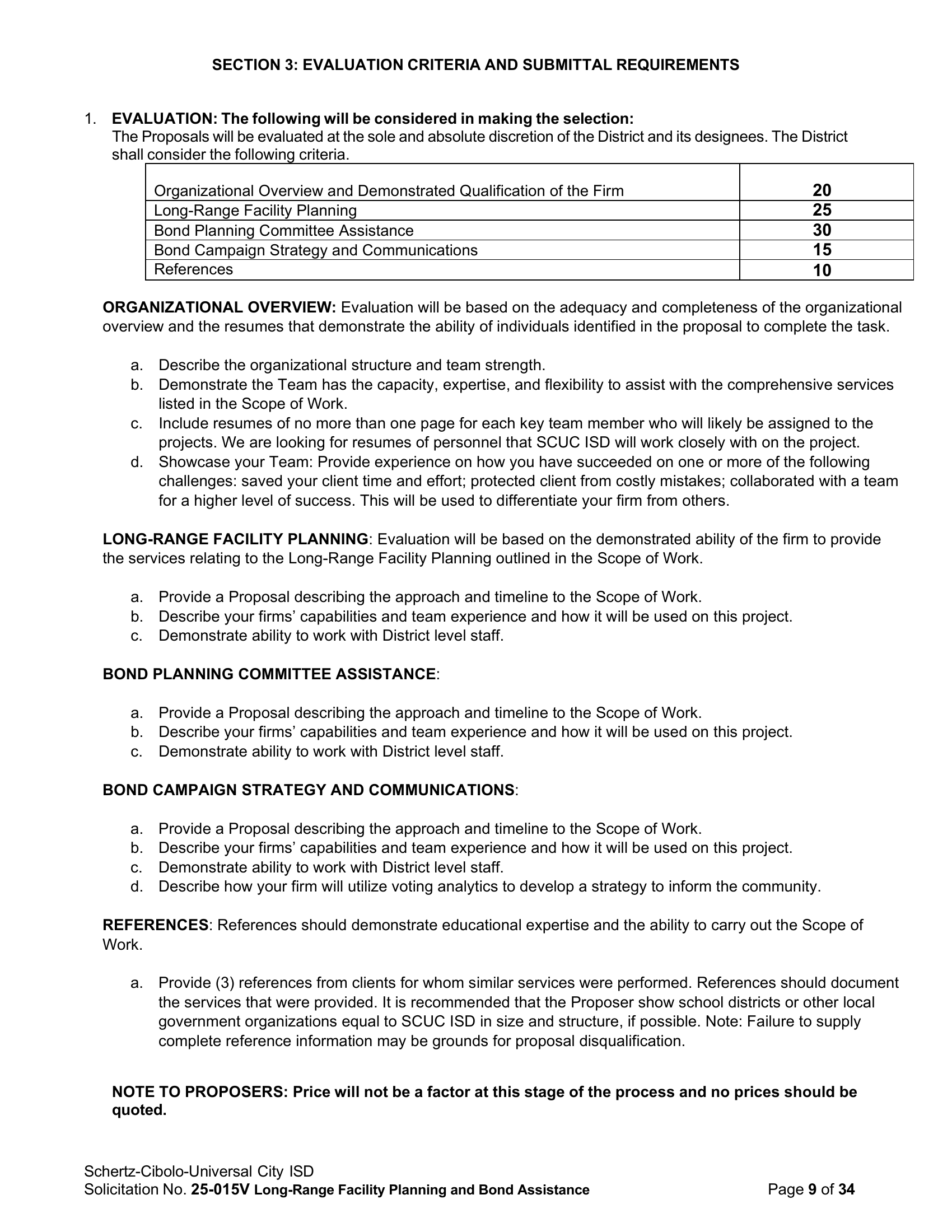
In April 2025, the board approved a contract with PBK Architects under RFQ 25-015V. Section 3 of the RFQ's scope of work is titled "Bond Campaign Strategy and Communications," and includes developing "target audience identification," "crisis communications and rapid response strategies to address potential opposition," and "utilizing voting analytics to inform community outreach strategies."
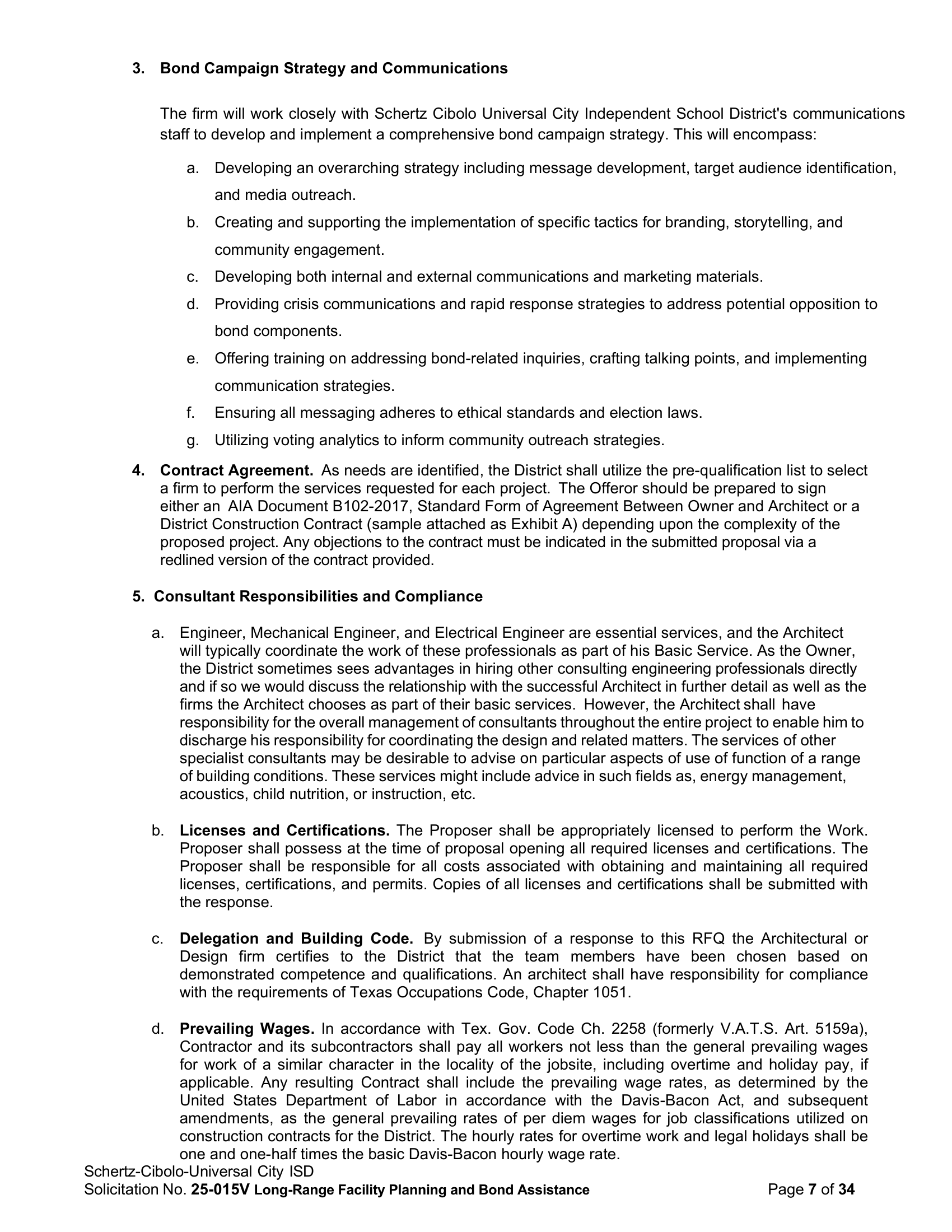
The evaluation criteria weighted "Bond Campaign Strategy and Communications" at 15 of 100 points, and specifically asked firms to "describe how your firm will utilize voting analytics to develop a strategy to inform the community."
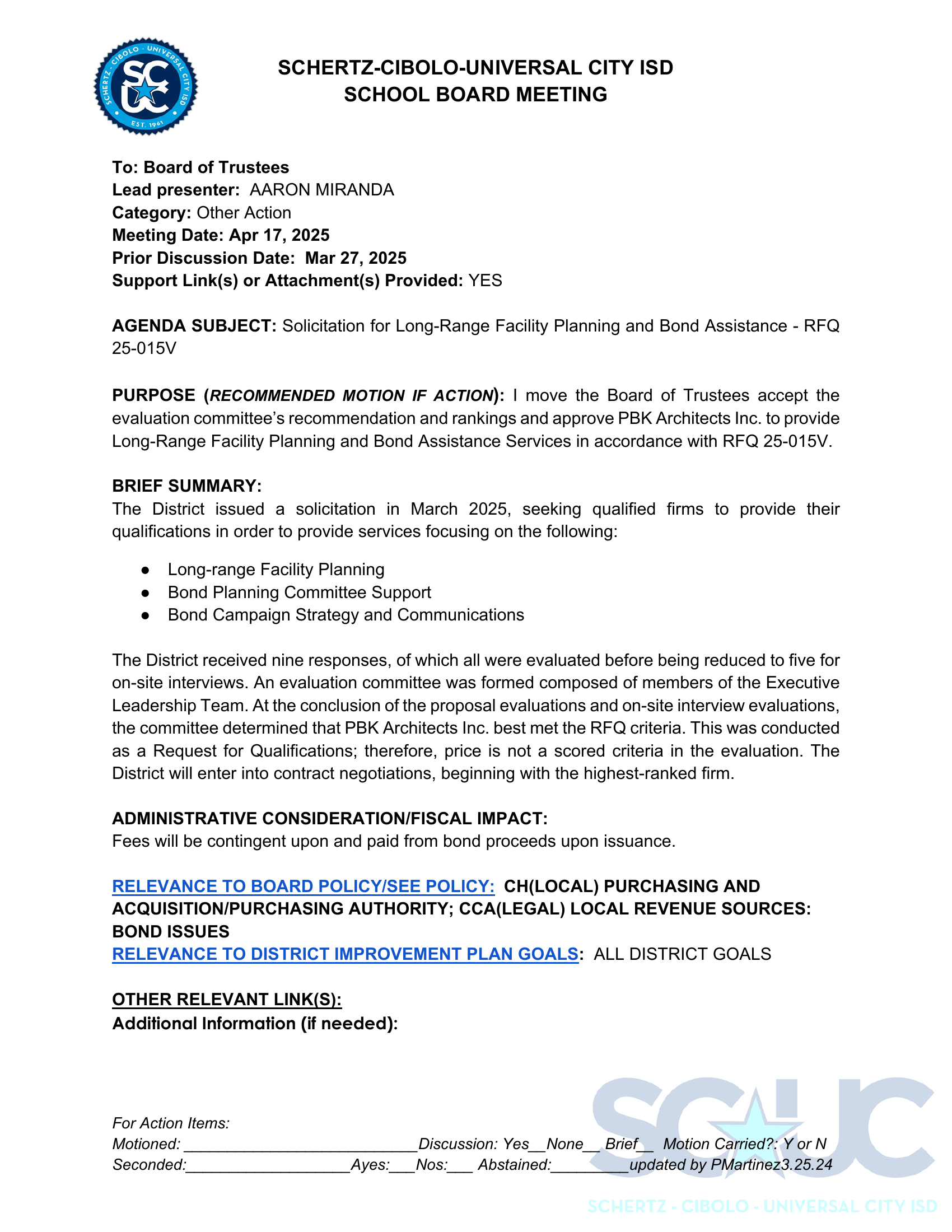
During the April 17 meeting, Chief Operations Officer JD Mosley told the board: "We really needed that campaign strategist that's gonna get us in there and really bring that strict campaign strategy." The board approved the hire unanimously.
The written agenda for that vote stated that PBK's fees would be "contingent upon and paid from bond proceeds upon issuance."
District records show PBK billed $70,000 in August 2025 — a 50% payment on a $140,000 line item labeled "Engagement Strategy & Creative Svcs TRE." The "TRE" designation refers to the Tax Rate Election that failed by 98 votes in November 2025. A contract originally approved for "Long-Range Facility Planning and Bond Assistance" was billing for TRE campaign services — paid from district operating funds, months before any bond election.
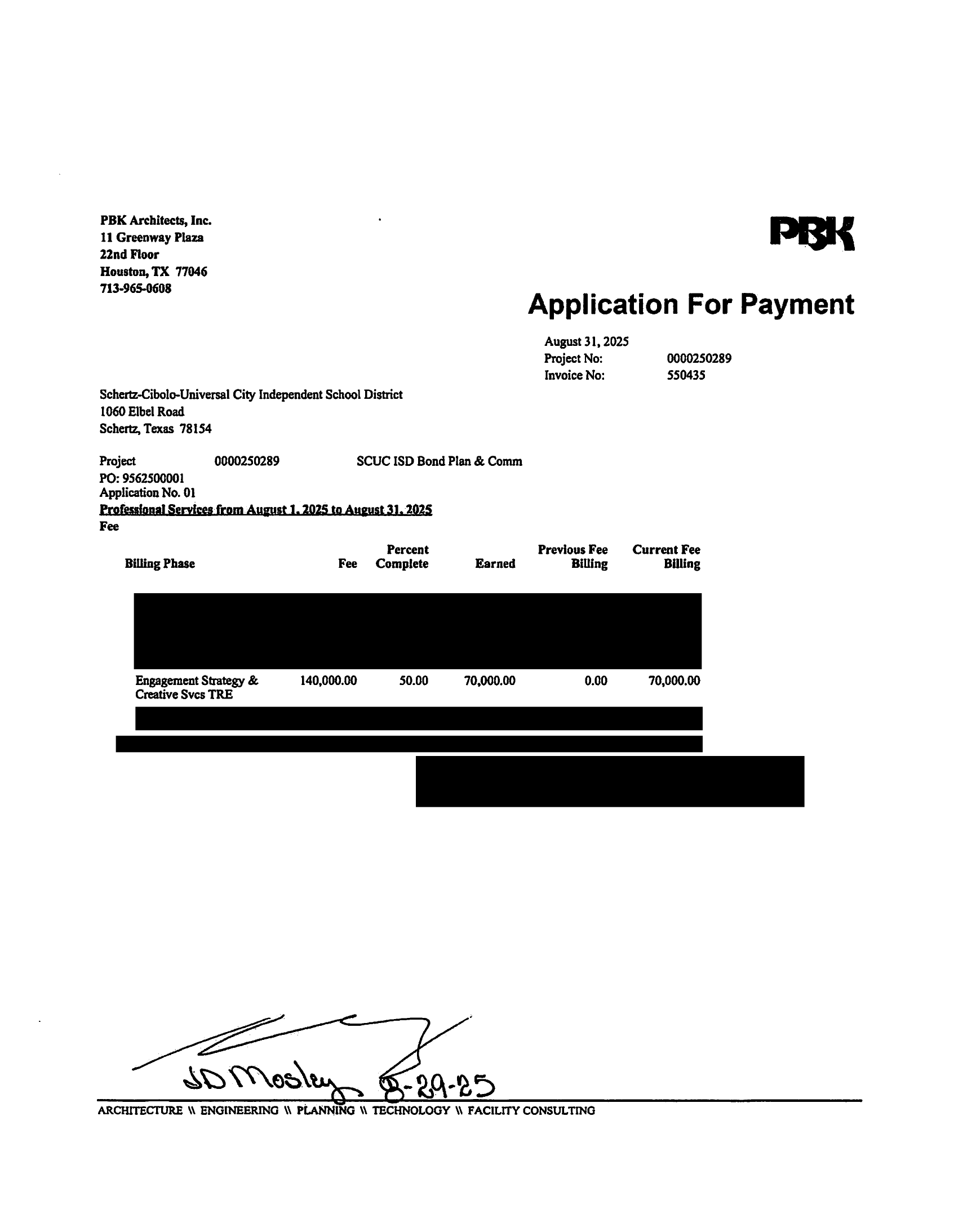
Whether the district subsequently amended the contract terms or authorized payment from a different source is unclear. A review of all 21 board meeting recordings from April 2025 through February 2026 found no agenda item to amend PBK's contract terms or authorize payment outside bond proceeds.
The closest reference came at the Sept. 25, 2025 regular meeting, when the chief financial officer presented a budget amendment that included PBK alongside other items such as Steele light poles, describing them as "large outstanding purchase orders" requiring re-funding across fiscal years.
"So what is this — this is just roll forward from the previous budget year then?" a trustee asked. The CFO confirmed.
The amendment passed 6-0 as part of a single vote covering all items. No trustee asked about the original contract language tying PBK's payment to bond proceeds, and no separate vote on PBK's contract terms occurred.
At the December 3 CAC meeting, Sheleah Reed — identified on the district's website as PBK's "Director of PreK-12 Engagement and Partnerships" — told committee members: "We have to make sure everyone sees themselves in the ballot."
PBK Architects has worked on bond efforts in other Texas districts. In Houston ISD, the firm served as a vendor for the 2024 bond planning process, which became the subject of a Texas Attorney General investigation into alleged illegal electioneering. That $4.4 billion bond ultimately failed. In Conroe ISD, watchdog groups raised questions about the role of bond vendors, including PBK, in political advocacy efforts. No criminal charges have been filed against the firm in either case.
In October 2025, the Texas Attorney General sent enforcement letters to four Texas school districts — including neighboring Judson ISD — accusing them of using taxpayer funds for illegal electioneering ahead of their own tax elections. The AG cited Texas Education Code §11.169 and Election Code §255.003, which prohibit school districts from using public funds or resources to advocate for or against a ballot measure. All four districts removed their materials and agreed to comply.
At the Jan. 8 regular board meeting, a trustee asked whether the district planned to reach "our 18 year old voters in our schools." "Absolutely. We'll do that with our economics classes in the spring," Meloni said.
At that same meeting, Meloni described the district's broader outreach efforts. The district was free to "really talk about things and not advocacy either way," she said, before adding: "We're on every campus... to the senior centers, to talk to the voters. We're on a campaign mission right now."
Other business
The board voted 7-0 to authorize pay for district employees during the Jan. 26 emergency school closure caused by hazardous winter weather.
Senate Bill 11: Prayer in schools discussion
Meloni previewed two resolutions the board will vote on at next week's regular meeting regarding Senate Bill 11, which requires districts to adopt a policy establishing a designated daily period of prayer and Bible reading — or formally decline to do so.
The administration recommends the board decline to adopt SB 11 and instead pass a separate resolution affirming students' and staff members' existing rights to voluntary prayer and religious text reading.
Adopting SB 11 would require parent permission waivers and separating students during the school day, Meloni said — and would not expand prayer rights already protected under current state and federal law.
"Regardless if we adopt this or not, all of our students and staff members are protected under the law to pray and read religious texts during the school day," she said.
No vote was taken. The item returns for action at the regular meeting.
What's next
The May 2 bond election is now officially on the calendar. Early voting begins April 20.
📌 We're watching this: The district has not published detailed project-level cost breakdowns within each proposition, nor explained the methodology behind its "no tax rate increase" claim. We'll report those details as they become available.
The Feb. 12 called meeting lasted approximately 25 minutes. All seven trustees were present. There were no public comments.
Further Reading
- SCUCISD calls $295M bond election — Community Impact News, Feb. 13, 2026
- SCUCISD trustees discuss potential May bond election — Community Impact News, Jan. 14, 2026
- SCUCISD Bond 2026 — SCUCISD official website